

Two facilities, one promise to send everyone home safe
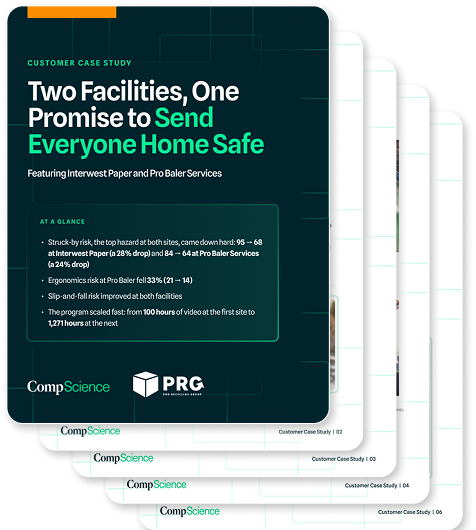
Salt Lake City's family-run commercial recycler brought CompScience into Interwest Paper and Pro Baler Services — and cut struck-by risk, the top hazard at both sites, by 28% and 24%.
Real risks — and no way to see them all at once
A recycling floor is a hard place to keep safe: cardboard, paper, and plastics moving through tight, non-climate-controlled spaces on forklifts, conveyors, and balers, all day, every day. Safety Manager Melissa Shaw knew the risks were real. What she didn't have was a way to see all of them at once, measure them, and prove where to act first. The first assessment at Interwest Paper made the stakes concrete — and two-thirds of its struck-by events were near-miss encounters between forklifts and workers on foot.
One playbook, scaled from the first facility to the next
100 hours
The first assessment. One week of footage put a dollar figure on injury risk and ranked struck-by as the dominant hazard on the floor.
1,271 hrs
The program scaled to the bigger site — same measurement, same playbook, on more than twelve times the video.
Hazards flagged for months, finally measured
CompScience risk specialist Brian Kim walked Melissa, Safety Director Mike Shaw, and their broker through the footage clip by clip — putting numbers and locations on what the team had long suspected.

Forklift–pedestrian near-misses
A forklift passing within a few feet of someone on the tipping floor. A loaded forklift with its view blocked. The exact moments Melissa was working to keep from turning into an injury.

Forklift bulldozing onto the conveyor
Forklifts pushing material onto the conveyor — common across the industry, and prohibited. "We probably need to stop," Mike admitted. No one flinched from what the footage showed.

Hand-tipping heavy Gaylord boxes
Workers tipping heavy Gaylord boxes with a twisting motion that strains backs and shoulders — repeated all day, every day.

Climbing bales and the conveyor
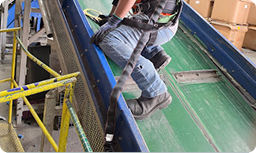
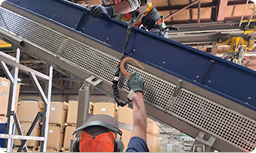
People climbing onto baled stacks and the conveyor instead of a proper platform — the routine that became the conveyor-access overhaul below.
Making Conveyor Access Safe
The first review captured a routine that worked in the moment but exposed workers: climbing the conveyor, moving between anchor points, reaching into the hopper. The team didn't reach for a single fix. Management, safety, and the employees who do the work built a layered procedure — engineering, administrative, and protective controls combined into one documented, repeatable process. The full step-by-step build is in the complete case study.
"Seeing the process from that perspective was a turning point for us. It wasn't about placing blame. It was about gaining a clearer understanding of the job and identifying where we could improve."
Melissa Shaw · Safety Manager
The top hazard came down hard — at both sites
The program's goal was a 25% struck-by reduction. The team beat it at Interwest Paper, then repeated it at a site with twelve times the footage. Slip-and-fall risk improved at both facilities.
The same approach worked at a small site and a large one, on the hazard that threatened workers most. CompScience customers average a 23% injury reduction once solutions are in place — Melissa’s crews are tracking right alongside it, facility after facility. The next target is already named: Caught In/Between, the one category that ticked up at both sites.

“Our team isn’t just a workforce — they’re like family. Safety for us isn’t about checking a box; it’s about making sure every single person goes home safe to their family at the end of the day.
”
Get the complete Pro Recycling Group case study
The full PDF includes everything the summary can't cover:
- Complete CompScore data and facility-by-facility progression
- Full risk findings across both sites
- The layered conveyor-access procedure, step by step
- The full action list — what Melissa's team changed on the floor
