


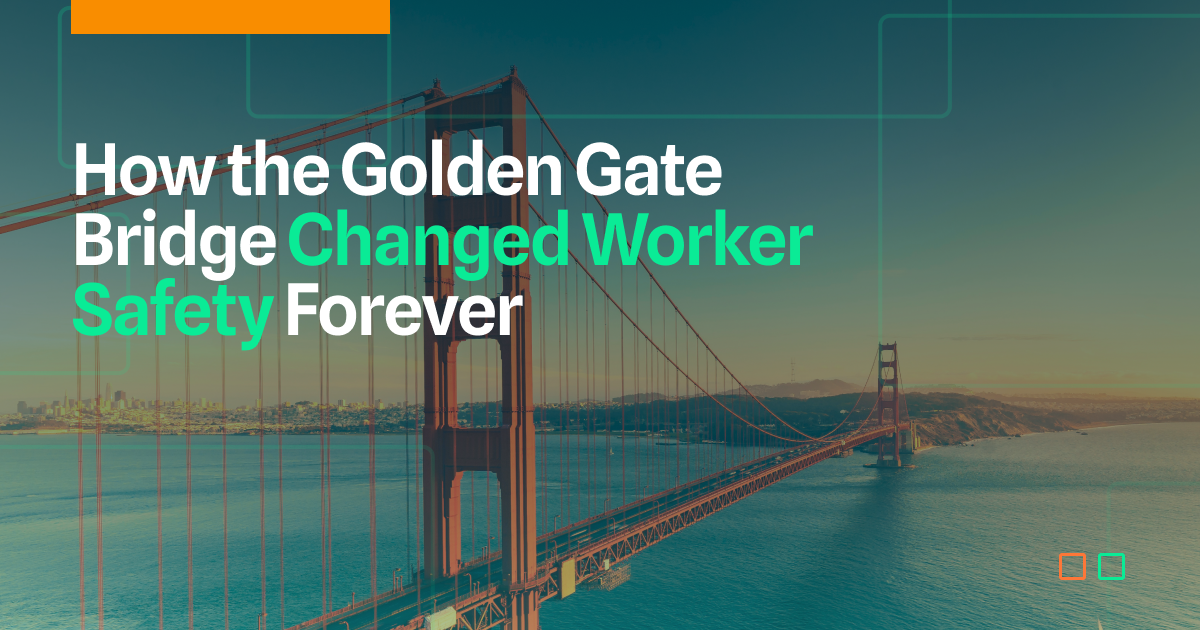
Joseph Strauss refused to accept that workers had to die to build it. The standard he set still defines the best safety programs today.
I see the Golden Gate Bridge almost every day. From my home in the Bay Area, it sits on the horizon like it has always been there. I drive over it every once in a while. I bike over it more often than that, which gives me plenty of time, somewhere out over the water while dodging tourists and fighting the crosswind, to think about the people who built it.
For me, it is a daily reminder of two things: what we can do when we decide to solve a hard engineering problem, and what we can do when we decide to prioritize the engineering solution that protects the lives of the people doing the work.
In the 1930s, building something big meant burying some of the people who built it. It was conventional wisdom; no way around it. The construction industry even put a number to it: one worker would die for every million dollars spent on a major project. It was not a fear. It was a planning assumption, as routine as ordering steel.
The Golden Gate Bridge was budgeted at $35 million. The math was simple and grim. Thirty-five men would lose their lives, and many more would be seriously injured.
Joseph Strauss, the bridge’s chief engineer, looked at that number and rebuked it. In a 1937 Saturday Evening Post article, he said he wanted to “cheat death by using every known safety device” his crews could get their hands on. He treated the situation as something engineering could solve, rather than a 35-soul price of progress.
And the engineering was daunting to say the least. The Golden Gate spanned a strait with brutal currents, needed to rise high enough for tall ships to pass beneath it, and had to withstand the heavy winds and fog that regularly rolled in. It was one of the hardest builds anyone had attempted. But the feat Strauss is still remembered for is the one that was nowhere near the top of the list: engineering the risk out of the work.
In Depression-era economics, labor was cheap, and another man was always waiting for the job. Strauss refused to think that way. He built in safety, and he treated his crew’s lives as part of the engineering, not a corner to cut.
The Net Everyone Remembers
The most famous of his devices hung beneath the deck, a safety net spanning the full length of the bridge. Strauss spent $130,000 on this safety feature, an enormous sum during the Great Depression. It reached 10 feet beyond the roadway on each side and helped ensure that, if a man slipped, he had something to catch him.
It worked. Of the 19 workers who fell, all of them lived. They called themselves the “Halfway to Hell Club,” and most of them went back to work on the bridge.
The Part Most People Miss
The net is where many people might have stopped, but Strauss pioneered what we take for granted today. He outfitted his crews with gear that almost no one used at the time, and now nearly everyone uses. He hired a manufacturer to build hard hats that were modified from miners’ helmets. These were among the first used on an American job site. He gave workers glare-free goggles so the sun off the water would not blind them and to shield them from flying debris. He handed out skin cream to protect against the wind, respirators so the men cleaning and riveting steel would not breathe lead-tainted fumes, and tie-off lines for anyone working where a gust could lift them off the edge. He ordered a special diet to fight the dizziness that came with working at great heights, and he built a field hospital beside the site.
Read that list again. Hard hats. Eye protection. Respirators. Fall lines. On-site medical care. Every one of them is standard today. In 1933, every one of them was Strauss, refusing to accept the status quo: that the work had to hurt, and sometimes kill, people.
The Math, Rewritten
For most of the four-year build, the project lost only a single worker, an almost unheard-of record for a job that size. Then, on February 17, 1937, a stripping platform tore loose and overwhelmed the net, killing 10 men in one morning. The final toll was 11, not the assumed 35.
Eleven deaths are not a triumph. Each one was a person and a family that did not get them back. But Strauss had proven that something the industry treated as a law of nature was actually a choice. The deaths were never the cost of the bridge. They were the cost of the safety someone decided not to build.
Foresight That No Longer Waits for the Fall
That is the whole idea behind what we do. Safety has improved dramatically over the past 90 years as we have built Strauss’ and others’ philosophies into occupational safety. We are at the point of another change in the way we think about safety.
Strauss could only catch a worker after he fell. The net was foresight, but foresight that activated at the last possible second. Today, you do not have to wait for the fall. CompScience watches the floor for the hazard before anyone slips. Analytics flag the forklift route, the blind corner, or the repeated near-miss that signals a serious injury is coming. The save happens upstream, before the worker is ever in the air.
That is the line CompScience customers are walking, and they walk it for the same reason Strauss did. They have decided the injury is not the price of running a business, but rather a problem you get out in front of. Every safety leader who puts a camera on a known hazard, every operator who fixes the near-miss before it becomes a claim, and every employer who treats “nobody got hurt today” as the actual goal is following the man who refused the math.
The Stat Worth Updating
And it shows up in the numbers. Employers who use CompScience reduce claims by 20%, cut the days their crews lose to injury, and bring down their total cost of risk, the full price a business pays for the accidents it does not prevent. Each of those points is a worker who finished the shift and a cost that never reached the books.
Strauss saved 19 lives and prevented thousands of injuries on one bridge. Scale that instinct across every warehouse, plant, and job site in the country, and the number grows by a lot. It becomes thousands, then hundreds of thousands, then a million injuries that never happen, and a million workers who go home whole.
Strauss proved it was possible with a net and a hard hat. We get to stand on Strauss’ work, and on everyone else who has been an advocate for safety since. The least we can do is return the favor for the people still doing the work.
Sources
Historical figures verified across Smithsonian Magazine (construction deaths and the Feb. 17, 1937 collapse), History.com (the $130,000 safety net and the Halfway to Hell Club), and Kattsafe and SelectView Data Solutions (the one-death-per-million-dollars rule of the era and Strauss’s safety gear). Official records list 11 worker deaths during construction; 10 died in the single 1937 platform collapse.
